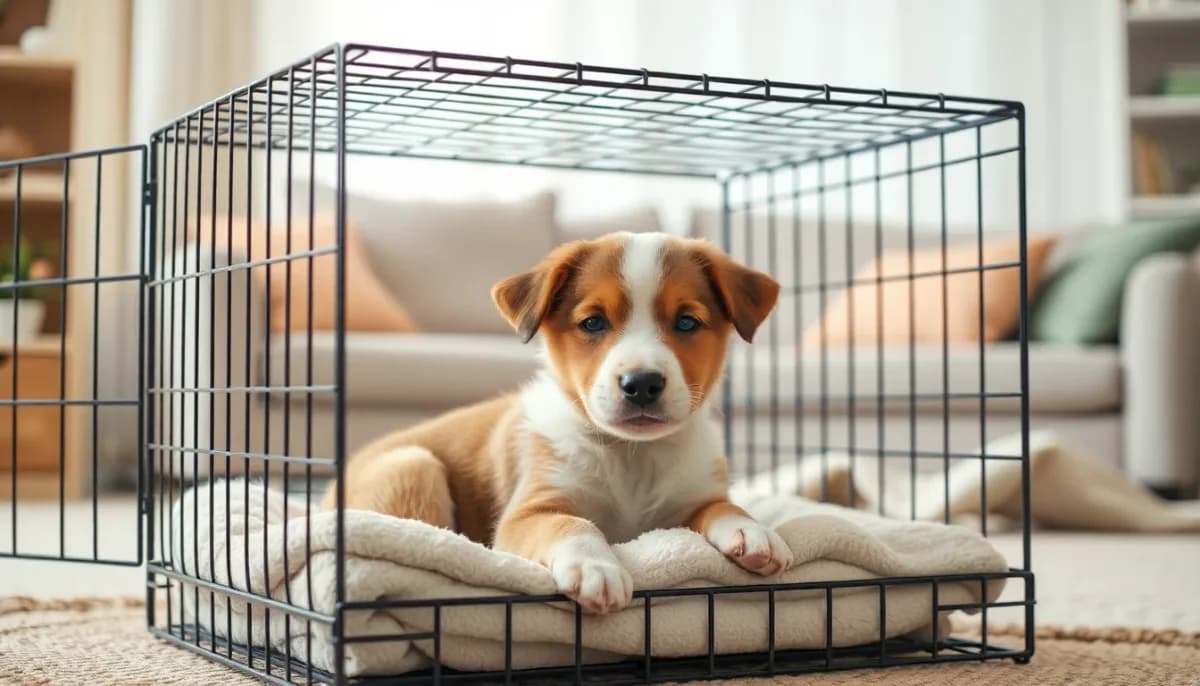
Key takeaways
- Crate training works best when the crate is introduced gradually as a safe, positive space — never as punishment.
- Most puppies can hold their bladder roughly one hour per month of age (plus one), so overnight schedules matter.
- Consistency and short, rewarding sessions are the fastest path to a crate-comfortable puppy.
- Whining at night is normal at first; responding correctly in the early days prevents bigger problems later.
- A properly crate-trained dog often chooses to sleep in their crate voluntarily — it becomes their den.
Crate training a puppy is one of the most effective things you can do for your dog's safety, your home, and your sanity as a new pet owner. Done right, the crate becomes your puppy's favorite retreat — not a cage they dread. This guide walks you through every step, from choosing the right crate to troubleshooting nighttime crying, so you and your puppy can get there as smoothly as possible.
What is crate training and why does it work?
Crate training uses a dog's natural instinct to seek out a small, enclosed den-like space. In the wild, canines rest in dens — confined spaces that feel secure and predictable. A properly introduced crate taps into that same instinct.
Beyond comfort, crate training delivers real, practical benefits:
- Accelerates housetraining. Puppies are reluctant to soil where they sleep, so the crate teaches bladder control faster than free-roaming ever could.
- Keeps your puppy safe. Unsupervised puppies chew electrical cords, swallow socks, and get into hazards you haven't even thought of yet.
- Reduces separation anxiety. A puppy who learns early that being alone is safe and temporary is far less likely to develop destructive anxiety later.
- Gives you peace of mind. Whether you're cooking dinner or running errands, you know exactly where your puppy is and that they're okay.
How do you choose the right crate size and type?
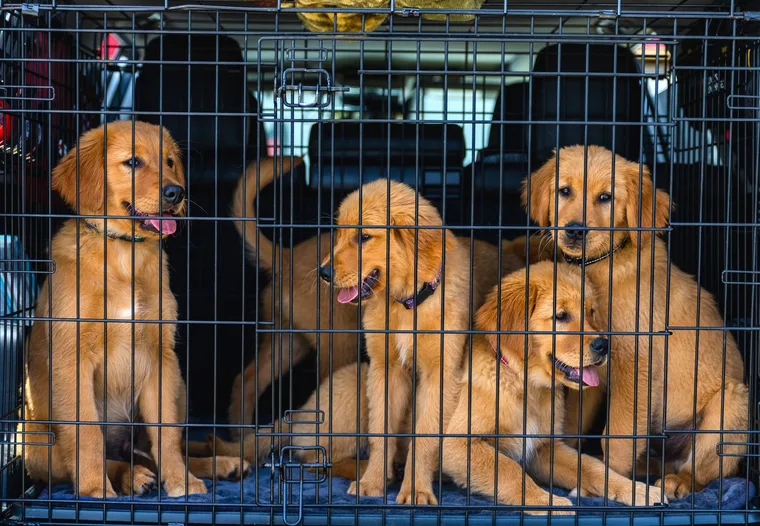
Choosing the wrong crate is one of the most common mistakes new owners make. Here's what to know:
Size matters — a lot
The crate should be just large enough for your puppy to stand up, turn around, and lie down comfortably. If it's too big, your puppy may eliminate in one corner and sleep in the other, which defeats the housetraining purpose entirely.
If you have a breed that will grow significantly, buy an adult-size crate and use a divider panel to section off a smaller space now. Expand the space as your puppy grows.
Crate types compared
| Type | Best for | Pros | Cons |
|---|---|---|---|
| Wire crate | Most puppies | Good airflow, collapsible, easy to clean | Noisier if dog moves it; less cozy feel |
| Plastic travel crate | Shy/anxious puppies | Den-like feel, airline-approved | Less visibility, harder to clean |
| Soft-sided crate | Calm, older dogs | Lightweight, portable | Not chew-proof; not for heavy chewers |
| Furniture-style crate | Home aesthetics | Blends into décor | Expensive; ventilation varies |
For most puppies, a wire crate with a divider is the most practical and versatile choice.
How do you introduce the crate for the first time?
The golden rule: never rush the introduction. A puppy forced into a crate before they're comfortable will associate it with stress — and that association is hard to undo.
Step 1 — Make it inviting before your puppy goes in
Place the crate in a busy area of your home (living room, kitchen) so your puppy doesn't feel isolated. Put a soft blanket inside, and if possible, a piece of your worn clothing so it smells like you. Leave the door open.
Step 2 — Toss treats and toys inside
Without any pressure, toss high-value treats (small pieces of chicken, cheese, or commercial training treats) just inside the door — then progressively further back. Let your puppy investigate at their own pace. This might take 10–20 minutes, or it might take a day or two. Both are normal.
Step 3 — Feed meals near, then inside, the crate
Start by placing the food bowl near the crate door. Over the next few meals, gradually move it inside. Once your puppy is comfortable eating inside with the door open, close the door briefly while they eat — then open it immediately when they finish. Gradually increase the time the door stays closed.
Step 4 — Build duration slowly
Once your puppy will enter on their own, begin giving a cue word ("crate" or "kennel") when they go in, reward them, close the door, sit nearby for 5–10 minutes, then let them out calmly (no big celebration — keep it low-key so exits don't become the exciting event).
Vet note: If your puppy shows extreme panic responses — sustained frantic crying, self-injury attempts, inability to calm down — consult your veterinarian or a certified professional dog trainer (CPDT-KA). Some puppies have underlying anxiety that needs professional guidance.
What is the best crate training schedule for a puppy?

Consistency is everything in crate training. Puppies thrive on predictable routines, and a good schedule prevents accidents while building positive habits.
The bladder-control rule of thumb
A puppy can generally hold their bladder for approximately one hour per month of age, plus one hour. So a 2-month-old can hold it for about 3 hours; a 3-month-old, about 4 hours. This is a guideline — individual dogs vary, and overnight they often do slightly better.
Sample daily schedule (8-week-old puppy)
- 6:00 AM — Wake up, immediately outside to potty
- 6:15 AM — Breakfast (fed in or near crate)
- 6:30 AM — Playtime and supervised exploration
- 7:30 AM — Outside to potty, then into crate for nap
- 9:30 AM — Outside to potty, brief play session
- 10:00 AM — Into crate
- 12:00 PM — Lunch, potty, play
- (Continue pattern throughout day)
- 10:00 PM — Last potty trip, into crate for the night
- 2:00 AM — Overnight potty break (most 8-week-olds need one)
As your puppy ages, the gaps between potty breaks can lengthen and the overnight trip eventually disappears — usually by 4–5 months of age.
How do you handle puppy crying in the crate at night?
Nighttime whining is the part most new owners dread — and it's the stage where many people inadvertently undo their progress.
First, distinguish between "protest whining" and a genuine potty need. A puppy who cried for 20 minutes and then settled is protesting separation. A puppy who was quiet and then suddenly cries intensely probably needs to go outside.
What NOT to do
- Don't let your puppy out of the crate because they're crying — this teaches them that crying is the escape key.
- Don't yell at or punish them — it increases anxiety.
- Don't cover the crate completely — some puppies feel more anxious, not less.
What actually helps
- Place the crate in your bedroom for the first few weeks. Proximity reduces distress dramatically.
- A snuggle puppy (a stuffed toy with a heartbeat simulator) can comfort puppies used to littermates.
- A white noise machine or a quietly playing radio helps many puppies settle.
- Keep overnight potty trips calm and boring — no talking, no play. Outside, potty, right back in the crate.
Remember: Most puppies adapt to sleeping through the night in their crate within 2–4 weeks when the process is handled calmly and consistently.
What are the most common crate training mistakes to avoid?
Even well-intentioned owners fall into these traps:
- Using the crate as punishment. The crate must always equal good things. If you send a dog to their crate when you're angry, they'll associate it with your anger — not rest.
- Crating too long, too soon. Puppies under 6 months shouldn't be crated for more than 3–4 hours at a stretch during the day. Extended crating causes physical discomfort and psychological stress.
- Making a big deal of departures and arrivals. Long, emotional goodbyes create anxiety. Matter-of-fact comings and goings teach your puppy that your leaving is no big deal.
- Giving up too early. Many owners quit after one or two hard nights. Puppies who seemed to hate the crate at day 3 are often sleeping in it voluntarily by week 3.
- Skipping the gradual introduction. Putting a puppy directly in a crate and closing the door without any prior positive association almost always backfires.
When can a puppy sleep through the night in the crate?
Most puppies can reliably sleep through the night in their crate — approximately 6–8 hours — somewhere between 4 and 6 months of age, though some do it earlier. Getting there requires:
- Consistent overnight routine
- Adequate exercise before bedtime
- Limiting water 1–2 hours before lights out (but never withhold water harshly — just don't leave a full bowl out at 9 PM)
- A crate that feels safe and familiar
Once your puppy is reliably sleeping through the night and has solid housetraining, you can begin giving them more freedom — a playpen, then a room, then eventually the run of the house (once they've proven they can be trusted).
Frequently Asked Questions
How long does crate training a puppy take?
Most puppies become comfortable with their crate within 1–3 weeks of consistent, positive training. Full housetraining and the ability to sleep through the night typically develops by 4–6 months of age.
Should I put a puppy pad inside the crate?
Generally, no. Placing a puppy pad inside the crate teaches your puppy that eliminating in their sleeping space is acceptable — the opposite of what you want. The only exception might be very young puppies (under 8 weeks) who physically cannot hold it, and even then, it's better to set up a larger pen with a designated pad area outside the sleeping zone.
Is it cruel to crate a puppy at night?
No — when introduced properly, crate training is not cruel. Dogs are den animals and most become genuinely comfortable in their crate. What IS harmful is confining a puppy for excessive hours or using the crate punitively. Used correctly, the crate gives your puppy a safe, predictable place to rest.
What do I put in a puppy's crate?
A soft, washable blanket or crate mat, a chew-safe toy, and ideally a piece of your clothing. Avoid anything with loose stuffing your puppy could ingest. Don't put a water bowl in overnight — it leads to accidents. During the day, a frozen Kong toy is a great addition.
My puppy keeps having accidents in the crate — what's wrong?
The most common reasons are: the crate is too large (shrink the space with a divider), the puppy was crated longer than they can hold it, or the puppy came from an environment (like a pet store or dirty kennel) where they learned it was okay to eliminate in their sleeping area. Be patient, reduce the crate time, and go back to basics.
Can you crate train an older puppy or adult dog?
Yes — the same principles apply, though adult dogs may take longer to warm up to the crate. The introduction should be even more gradual, and patience is especially important if the dog has any history of negative confinement experiences.